

Industrial manufacturers are entering a new phase of digital transformation. For years, the focus was on dashboards, alerts, and visibility: collecting machine data, tracking KPIs, and helping teams understand what was happening. That phase created important foundations, but it also exposed a limitation. Visibility alone does not solve operational bottlenecks. A planner still has to reschedule. A warehouse coordinator still has to interpret shortages. A back-office operator still has to read documents, copy values, validate exceptions, and trigger the next step.
In 2025 and early 2026, the conversation across the software market shifted toward agentic AI and outcome-oriented enterprise systems. Deloitte's 2026 manufacturing outlook explicitly points to continued investment in smart manufacturing technologies, including agentic AI, while Reuters recently reported Oracle's move toward "agentic apps" designed to help users request outcomes rather than merely operate software screens.
What does "agentic" mean on the factory floor?
In practical terms, an agentic workflow is a structured sequence in which software does more than observe. It can interpret an event, use context, apply logic, involve humans when needed, and trigger actions across systems. Instead of a classic automation that follows one rigid script, an agentic workflow can combine document understanding, retrieval of company knowledge, rule-based steps, AI reasoning, and integrations with operational systems.
This is especially relevant in manufacturing because many real processes are messy: PDFs arrive in different formats, planning priorities change during the shift, the same exception requires different actions depending on the customer, machine, warehouse status, or lead time. The World Economic Forum has described AI agents as amplifiers of real-time decision-making and seamless human-machine collaboration in manufacturing, while McKinsey has emphasized that the value comes when AI is embedded into operating models, governance, and change management — not treated as a disconnected pilot.
Where donia® fits in
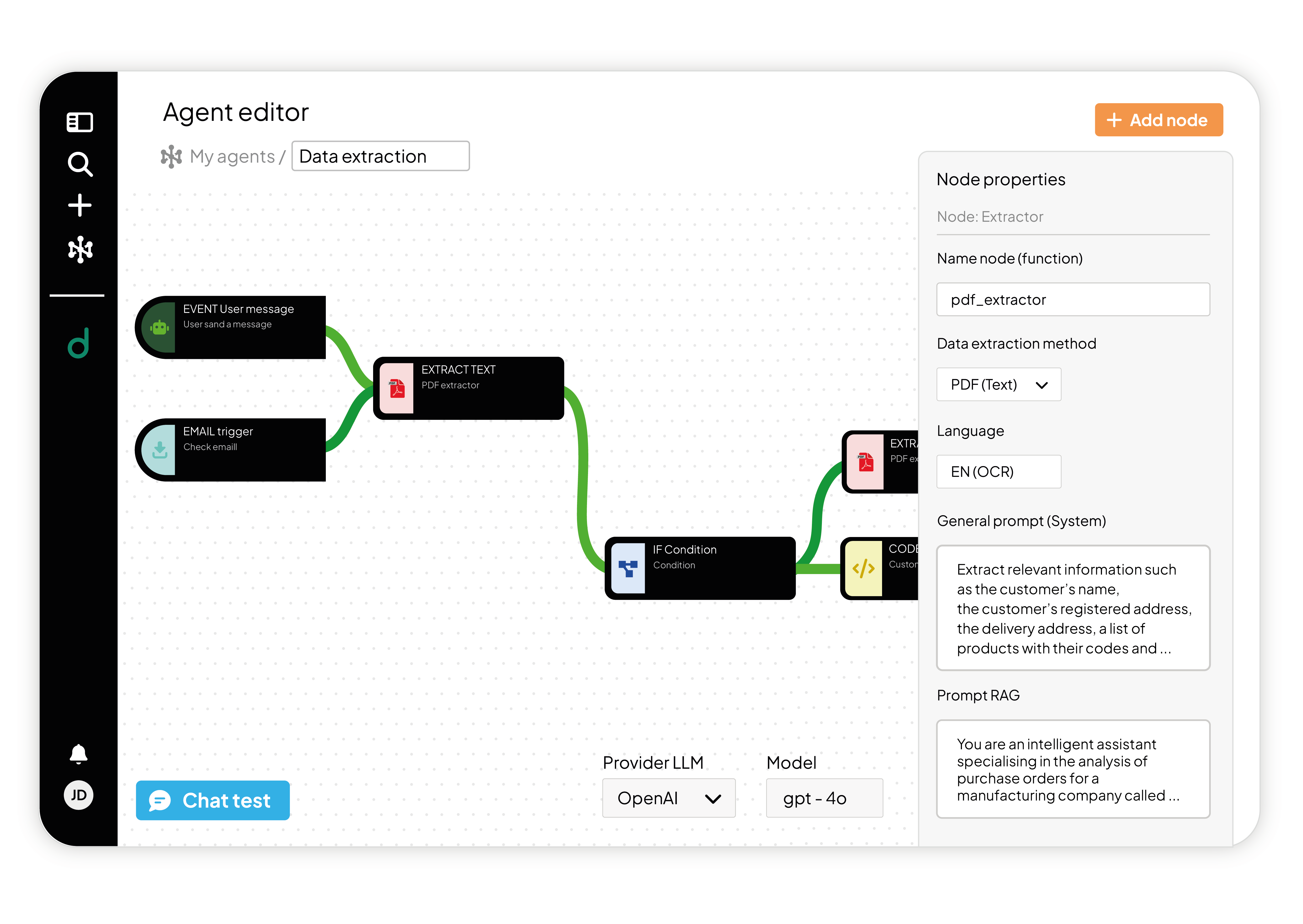
This is the gap platforms like donia® are designed to address. In an industrial context, a useful workflow builder should not be a generic no-code toy, and it should not be only a chatbot wrapper. It should let teams connect operational events to industrial actions. A practical workflow can begin with a production order, an incoming PDF, an operator question, or an ERP signal. From there, the flow may extract structured data from a document, compare it with ERP records, query production constraints, classify urgency, retrieve relevant procedures, and either create a recommendation or trigger an action.
In some cases, the output is a structured JSON object. In others, it is a system update, a planning suggestion, a warehouse alert, or a guided response for an operator. The important point is that the workflow is not just "AI speaking" — it is AI operating inside a governed process.
The four-layer architecture
A good starting point is to think in four layers:
- Trigger — What starts the workflow? A file upload, a user message, a schedule deviation, a customer order, a stock exception.
- Context — What information must the workflow gather to understand the situation? This can include documents, ERP data, MES data, warehouse states, planning rules, product constraints, or prior conversations.
- Decision — Which rules are deterministic, and which require AI interpretation? Not everything should be delegated to a model. Industrial workflows work best when rules, thresholds, and human approvals are explicit.
- Action — What should happen at the end? Notify, escalate, write to a system, produce a summary, generate a plan, or prepare a human decision.
This architecture is far more useful on the shopfloor than a generic prompt box, because it reflects how real operations run.
The business case
For industrial teams, the business value is straightforward. Agentic workflows reduce repetitive interpretation work, shorten response times, and standardize how operational knowledge is applied. They also make AI more accountable because each step in the flow can be visible, versioned, tested, and improved over time.
That matters: McKinsey's 2025 and 2026 AI research repeatedly shows that scaling value depends less on isolated model quality and more on operating discipline, data readiness, and adoption practices.
The practical lesson
Manufacturers do not need more disconnected pilots. They need workflows that connect events, data, logic, and action. That is where agentic manufacturing becomes real. And that is the space where donia® can create a distinctive position: not as a generic automation clone, but as an industrial workflow platform built around the real language of operations.