

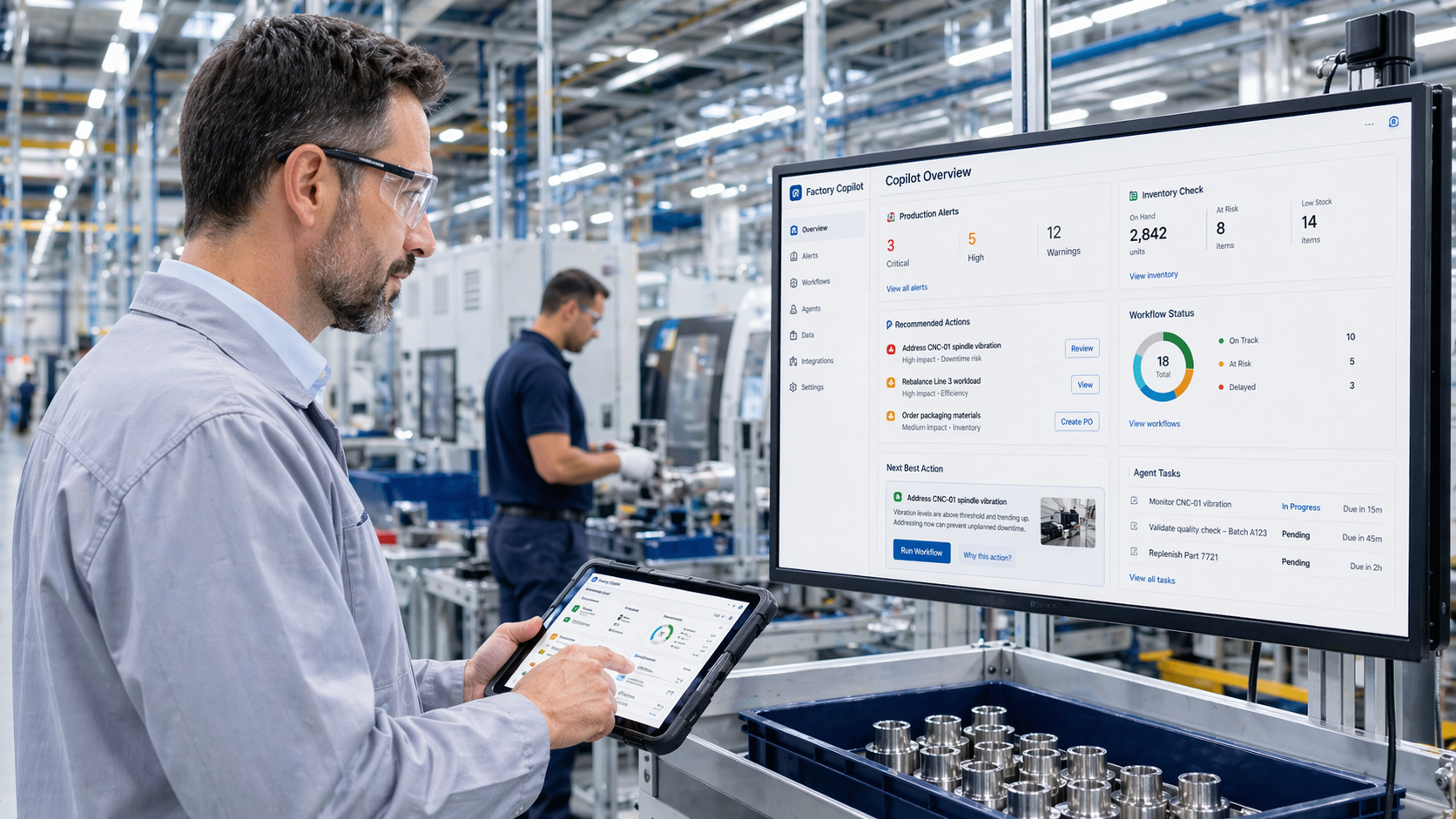
In the early wave of generative AI adoption, many industrial use cases were framed around copilots. The idea was intuitive: a conversational assistant that could answer questions, summarize documents, or help operators and engineers access information more quickly. That model remains valuable, but it is no longer the frontier. In 2025 and early 2026, the discussion moved decisively toward AI agents: systems that do not just respond to prompts, but pursue goals through workflows, tool use, and coordinated actions.
The shift is visible across enterprise software, consulting research, and industrial vendor messaging. Reuters recently described Oracle's move from standalone AI agents toward "agentic apps" embedded across enterprise workflows, while McKinsey and the World Economic Forum have both highlighted the strategic relevance of agents and multi-agent systems for operational environments.
Copilot vs. agent: a meaningful distinction
For factories, this is a meaningful distinction. A copilot is useful when a worker needs fast assistance: summarize a maintenance report, explain a standard operating procedure, compare two specifications, translate an issue note, or retrieve the likely cause of a recurring problem.
An agent becomes relevant when the task spans multiple steps and systems. For example: detecting a production deviation, pulling machine context, checking available inventory, reading the customer priority, proposing a response, and routing the recommendation to the right person. Or extracting data from an incoming order, validating it against ERP records, checking scheduling feasibility, and preparing the next transaction. These are not single prompts. They are operational flows.
Why the phrase "AI stack" matters
Factory AI is no longer just about the model. It includes triggers, retrieval, tools, workflows, governance, system connections, user roles, and auditability. Microsoft's recent manufacturing narratives increasingly frame AI as the interface to industrial data and operations, while Siemens is showing generative AI much closer to the production environment than before. Infor has gone further by explicitly describing 2026 as a year in which agentic AI starts to transform industrial manufacturing — including workflows that can identify deviations, adjust schedules, update work orders, and trigger follow-ups.
What changes in practice
First, AI projects become more process-centric. Companies stop asking "Where can we add a chatbot?" and start asking "Which operational workflow contains repetitive interpretation and decision latency?" Second, the importance of context grows. A factory agent without access to production data, master data, document context, and business rules is just eloquent software. Third, governance becomes non-negotiable. McKinsey's research repeatedly underlines that value at scale depends on operating models, human validation practices, and adoption discipline. In a factory, that matters because actions affect real materials, schedules, and commitments.
A change in product philosophy
There is also a strategic lesson for product builders. The winning industrial AI platforms will not be those that simply expose a chat box over company data. They will be those that combine language with execution. In manufacturing, people care about throughput, shortages, lead times, traceability, exceptions, and service levels. AI earns trust when it reduces friction inside those realities. That is why the move from copilots to agents is more than a technical upgrade. It is a change in product philosophy.
Factories are a strong fit
The most exciting part is that factories are actually a strong fit for this transition. Manufacturing already has structured processes, recurring events, known roles, and measurable outcomes. That makes it one of the best environments for grounded, workflow-based AI. The hype will fade, as it always does. But the operational logic behind agents is likely to stay. And for industrial teams, that is where the real opportunity begins.