

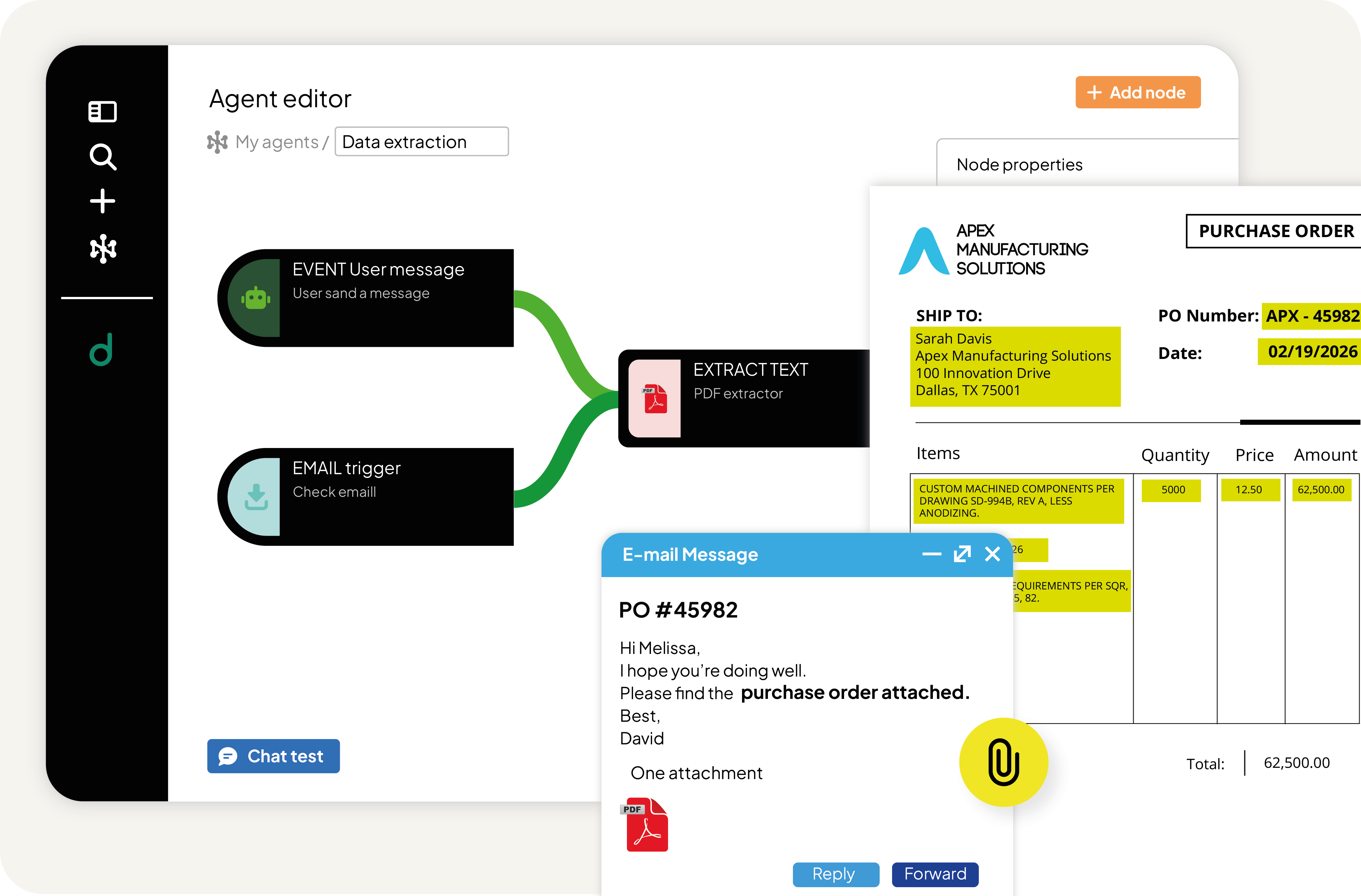
For many manufacturers, digitalization still breaks at the document boundary. Orders arrive as PDFs. Technical sheets are emailed as attachments. Packing lists, invoices, compliance documents, delivery notes, and production specifications often enter the company as unstructured files. Traditional OCR solved part of the problem by making scanned pages searchable, but that is no longer enough. In manufacturing, the real challenge is not to "read text from a page." The challenge is to transform industrial documents into trusted operational inputs.
This is why document intelligence is emerging as a strategic layer for modern operations platforms rather than a narrow back-office utility. Recent industry analysis and product direction from enterprise software vendors increasingly frame AI as a way to orchestrate tasks, extract meaning, and support decisions across processes — rather than simply digitize files.
The problem with OCR-only thinking
The problem with OCR-only thinking is that it stops too early. If a purchase order PDF becomes a block of text, the operational work has barely begun. Someone still needs to identify the customer, delivery address, line items, requested date, quantities, units of measure, references, anomalies, and exceptions. Then that information has to be mapped to internal master data, validated against ERP structures, and used to trigger the next action.
In many factories, this work is still manual because the data is messy and contextual. The same field may appear in different positions across suppliers. The same item may be described with a commercial name in one document and an internal code in another. Some orders are clean, while others contain handwritten notes, partial tables, or customer-specific language. A system built only on OCR will pass the complexity to humans. A system built for document intelligence will absorb more of that complexity inside a controlled workflow.
Where architecture matters
A useful industrial document workflow usually combines multiple capabilities: text extraction, table recognition, metadata capture, classification, retrieval of business context, AI-based interpretation, and downstream action. The output should not be a paragraph. It should be a structured object ready to be checked, enriched, or inserted into a business process.
That object might be JSON for an order import, an exception list for a planner, a discrepancy report for customer service, or a validation package for an approval flow. In other words, document intelligence becomes valuable when it connects directly to execution. Microsoft's recent manufacturing positioning around industrial AI repeatedly emphasizes AI as an interface to operational data and workflows, while Siemens and other industrial players are showing more examples of generative AI being used near the shopfloor, where context and action matter as much as extraction.
Document-to-action with donia®
For a platform like donia®, this opens a strong and concrete product story. Document intelligence should not be sold as "AI reads PDFs." It should be framed as document-to-action infrastructure. A customer uploads an order, and the platform extracts structured fields. A rule checks whether the delivery date is feasible. A retriever looks up product constraints. A second node validates whether customer references match ERP records.
If confidence is high, the workflow prepares the ERP insert. If confidence is low, it routes the exception to a human with the right evidence attached. The point is not merely automation — it is operational continuity with traceability.
Governance is not optional
This matters even more as manufacturers try to move beyond pilots. McKinsey has argued that operational impact from gen AI and agentic AI comes when governance, workflow design, and human validation are built in from the start. That principle is especially true for industrial documents, because a wrong quantity or incorrect code can create a chain of execution problems across planning, procurement, warehouse, and invoicing.
A more mature narrative
The market is ready for a more mature narrative. OCR converts images into text. Document intelligence converts documents into operational decisions. For manufacturing companies, that difference is enormous. And for donia®, it is a natural entry point because documents are still one of the most universal and painful interfaces between the outside world and factory operations.