

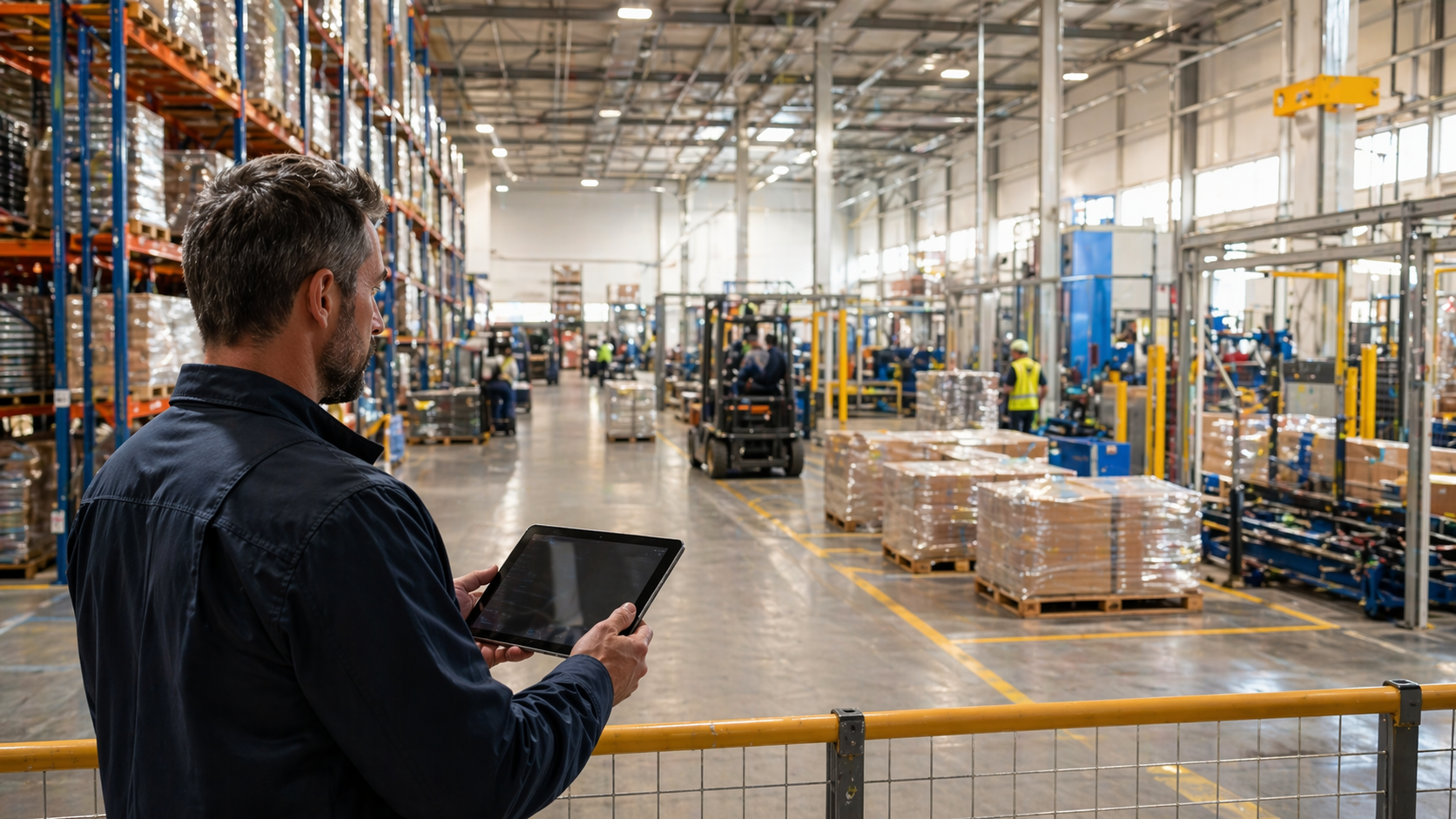
Warehouse software used to be evaluated mainly on visibility. Could it show stock? Could it manage locations? Could it support barcode transactions? Could it improve inventory accuracy? All of those capabilities still matter, but in 2026 they are becoming baseline expectations rather than strategic differentiators. What manufacturers increasingly need is software that helps the warehouse operate as an active execution system tied directly to production flow.
The shift is subtle but important: from recording where things are, to deciding what should happen next. Industry commentary in 2026 reflects this direction, with growing emphasis on execution-level automation, intelligent slotting, and the tighter coordination of warehouse activity with factory priorities.
The warehouse is not a logistics island
This is especially relevant in manufacturing environments because the warehouse is part of the operating heartbeat of the plant. Material availability influences sequencing. Picking delays affect line continuity. Incorrect staging creates wasted labor and machine idle time. Poor location logic increases travel distance and exception handling.
Traditional warehouse software often does a decent job of tracking transactions after the fact, but it may do less to optimize operational flow in real time. That is why manufacturers are showing more interest in systems that can prioritize tasks dynamically, recommend material movements, support replenishment logic, and align warehouse execution with production urgency rather than with static lists.
Three forces shaping the next generation
The next generation of warehouse tools is being shaped by three forces:
- AI and analytics are improving slotting and placement decisions, which matters in environments with high SKU variety and changing demand.
- Event-driven execution engines are replacing manual queue inspection — software can route the next best task to the right operator or device automatically.
- Tighter system integration is connecting warehouse logic more closely to ERP, MES, planning, and document workflows.
The World Economic Forum's work on physical AI and industrial operations points to warehouses as one of the environments where intelligent automation, sensing, and adaptive systems are gaining operational relevance. Deloitte's broader 2026 technology work also highlights the growing role of AI-centered infrastructure and robotics across industrial settings.
Visibility vs. execution: a concrete difference
For manufacturers, the practical implication is that "WMS" should be rethought as part of an operational execution fabric. Consider a simple but common scenario: a priority production order is at risk because one component is in stock but not staged. A classic system may tell the coordinator that inventory exists. A more advanced system should detect the risk, identify the exact location, assign the movement, consider equipment constraints, and confirm completion with minimal delay.
Or imagine inbound goods arriving against a customer-driven production sequence. The useful question is not simply where to store them, but how receiving, putaway, and staging can support tomorrow morning's production priorities. This is the difference between visibility and execution.
Better coordination for real operators
Rockwell's 2025 State of Smart Manufacturing research shows the continued willingness of manufacturers to invest in AI and digital transformation to improve performance and support their workforce, while Microsoft and other vendors increasingly present industrial AI as a way to bring timely operational insight to frontline workers. The best warehouse software direction, therefore, is not full autonomy in a science-fiction sense. It is better coordination for real operators in real environments.
Decide what to do next
The warehouse is one of the clearest places where AI, workflows, and manufacturing operations meet. It is close enough to measurable ROI, but complex enough to demonstrate the value of intelligence beyond simple reporting. In 2026, the most interesting warehouse platforms will not be the ones that merely know what happened. They will be the ones that help the operation decide what to do next.